All tied up with string
In this blog, Tobar an Dualchais and ATLAS Arts' artist in residence Susannah Bolton describes her visit to the School of Scottish Studies Archives in Edinburgh, where the majority of recordings on TAD originate.
Arriving at the School of Scottish Studies, the present-day morning became muffled by warm welcomes and wood panelling. Lily shows me where the index cards are, and I’m settled in an instant. Textiles take me to obair a' chlò, gu slàt Ghàidhealach, —mun cuairt gu tomhaisean, thairis gu coiseachd anns na seann làithichean, tro sgeulachd an liosadair, the preparation of oilskins, suas gu obair lìn an Cnoc an Torran, and across to a filing cabinet with a series of photographs of rope making.
My mind wanders round to the fieldworkers. Trekking and talking as a practice! Collecting bundles of lives lived and bringing them back to the archive for people to visit, revisit, listening closely to speckled words snipped and clipped into flavourful criomagan.

A few summers back I decided to understand how time works. Planck scale is supposed to be the level of detail you reach when time is no longer real, so small it's all movement and no direction. Physicists haven't quite explained the space-time anomaly that definitely, certainly occurs when there are lots of interesting things in one room and only half a day to absorb it all.
So, after a mere ten minutes, absolutely not more, it was afternoon and the archive’s curator, Cathlin, was ready to open locked doors to the materials she cares for.
Rolling stacks opened layer after layer, each filled with slim cardboard volumes: the reels. The spools of sound made physical! I learned that 1,200 feet of audio, wound in a seven inch spiral, stores around forty minutes of audio. Upstairs, a fragile groove coils tightly around and along the wax cylinders able to instruct a graphophone needle with etched words for barely hundreds of seconds. A fitting emblem of the archive, the spiral of linear listening time can in fact be read in both directions.
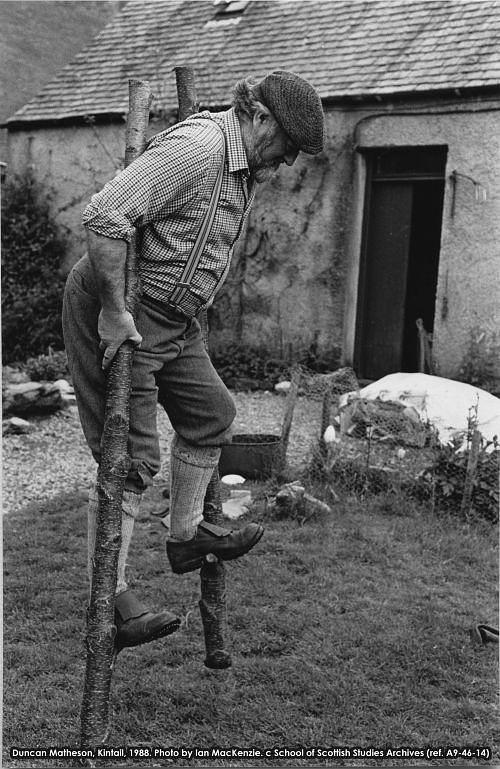
In another room, I spied a pair of celebrities. In 1988, Duncan ‘Stalker’ Matheson walked around his garden on his casan-maide made from local alder and told fieldworkers how to make a river crossing on these wooden legs. Stalker’s stilts now lie in the archive, distinct in material nature from their roommates. Packaged in opalescent glassine and tied with finger’s width cotton tapes, there is a sacred air to these retired limbs. Their time wading water is done — now they shoulder ideas of resourceful adaptation with them, storied and shared across meandering social networks.
Moving to leave, piling on my layers of wool in insulation from the sharp cold, Cathlin hands me a muted bundle. They are a trio of Tocher journals bound by four lines of unbleached cotton string (naturally) - for the road, for the future, to take me further along, she gestures.
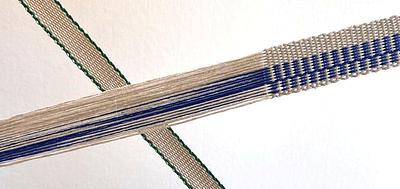
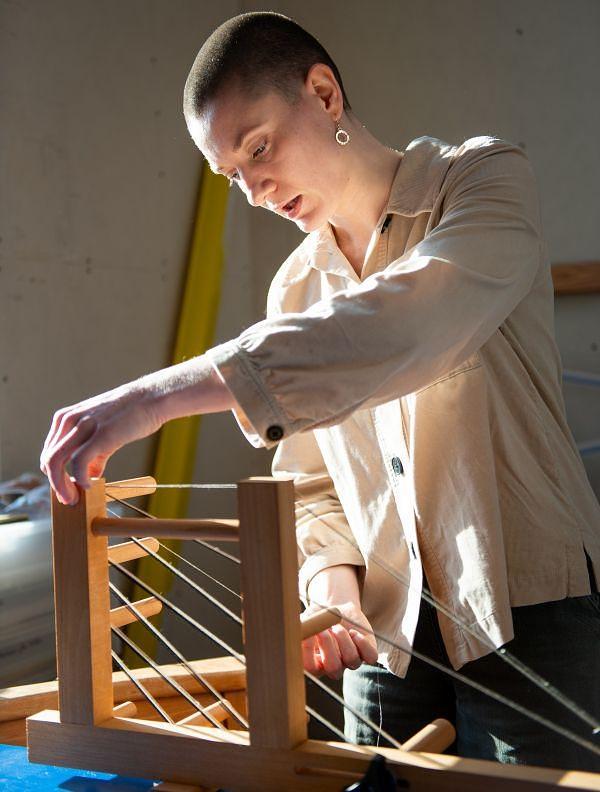
I’m away home now, making my own lengths and lines: I’m weaving narrow webbing strips and writing a wide-ranging essay that is mostly about things tied up in bundles. I hope to share some of my distillations in the coming months. The index cards and search keywords have led a merry dance that I’m still unpicking the knots of.
I wouldn’t be navigating the archives to such depths without the support of ATLAS Arts and Tobar an Dualchais who are hosting me through their research residency, so a special thanks to Floraidh, Heather, Katharine, Robyn, and Ainslie for creating this framework. Thanks also to Lily and Cathlin for being the perfect guides when I visited the School of Scottish Studies to find a sense of tangibility alongside the digital.
The School of Scottish Studies Archives is located on George Square, Edinburgh. To arrange an appointment contact the University of Edinburgh's Heritage Collections via email: [email protected]