A Voice and a Name
Our Scots Cataloguer, Chris Wright, discusses how a mystery fieldworker was finally identified...
One of the most interesting aspects of the work we do at Tobar an Dualchais is the uncovering of new information about our recordings and the people they feature during the process of getting the audio ready to go online. Occasionally, we happen not to have very much information to go on when trying to identify who has been recorded, where, when, and by whom. Almost all our recordings were made before the internet existed and before computers were in widespread use, and so paper records are usually the default resource we have to help us. So what happens when those records are incomplete or even non-existent - when all we have is a tape with a voice and (if we're lucky) a name?
This can happen when recordings were made on the hoof: perhaps the chance to record the name of a singer at a folk festival was overtaken by events, or maybe their name never made it into the fieldworker's notebook due to simple omission. We have processes for dealing with such recordings, where we make every effort to identify the person, and only then consider whether it would be acceptable to publish the track under our risk management (i.e. 'take-down') policy. But what happens when it's the fieldworker themselves who is unknown? That might sound strange, given that our archives are primarily made up of recordings made by professional fieldworkers or graduate students. How could we not know who they were?
In most cases, it's simply not clear why this infomation is missing - maybe the records depended on another set of records for clarification, or maybe the archivist thought a simple surname would be enough to identify the person in question. Whatever the case, it presents us with a particularly significant challenge. In contrast to an unknown contributor, who may have even only a single recording, some unidentified fieldworkers made tens or even hundreds of wonderful recordings which we'd like to share with the world, and so it behoves us to try to identify them especially. In one particular case, we had several hundred recordings made in 1971 by a fieldworker simply listed in paper records as 'De Groot'. Since we had many other well-documented fieldworker's recordings to process, De Groot's recordings had to wait either until we came across supporting information by chance, or until we'd reached the end of our documented holdings and could turn our attention to our list of mysteries.
As often happens with these things, it was a parallel endeavour that provided the vital clues that allowed us to track down De Groot. Some years ago, I was fortunate enough to be given access to the personal papers of one of the most important folklorists and fieldworkers from the School of Scottish Studies, Hamish Henderson (1919-2002) , as part of a small team helping organise his papers with a view to their being secured for the nation in an appropriate archive. Eventually, the Centre for Research Collections at the University of Edinburgh purchased the collection and they are now available to researchers for study in a world-class institution. As part of my work before they were transferred to the University, Hamish's letters were sorted alphabetically and collated, with details of the sender, date, location, etc, recorded on a spreadsheet. Ruminating on the mysterious De Groot one night, it suddenly occurred to me that it would be trivial for me to search this old spreadsheet to see if Hamish and 'De Groot' had corresponded. And this is how a persistent mystery was finally resolved: Rokus De Groot was the name that popped out, along with mention of a colleague named Marita Kruijswijk.
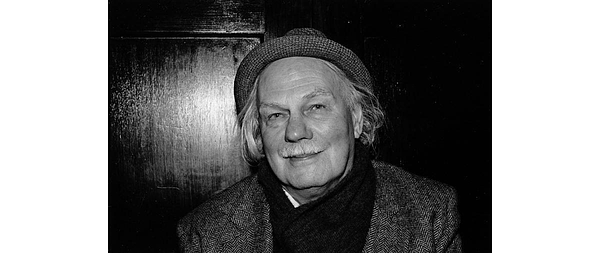
Hamish Henderson, folklorist and fieldworker at the School of Scottish Studies at the time of Marita and Rokus' trip to Scotland
A quick Google search was all it took to locate these researchers, and I was able to follow up by e-mail to confirm that I had the right people. Rokus de Groot and Marita Kruijswijk had been Dutch musicology students at the University of Amsterdam in 1971. A chance encounter with a Scottish folk-band on tour in the Netherlands had inspired Marita to consider coming to Scotland for ethnomusicology research as part of her degree. Rokus was similiarly enthusiastic, so they approached their teacher, Ernst Heins, who was in contact with Hamish Henderson of the School of Scottish Studies. It was arranged that the students would conduct six weeks of fieldwork in Scotland under Hamish’s supervision, with the pair arriving in Edinburgh in the summer of 1971. Marita recalls:
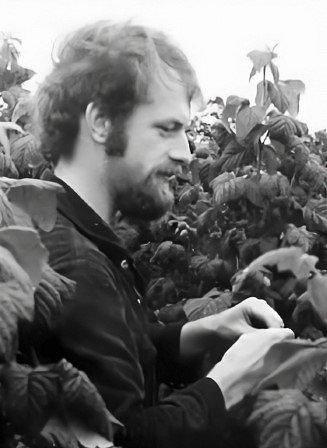
“Hamish Henderson gave us addresses from all kinds of musicians, and he also lent us a tent in case we couldn’t find an overnight stay. So we visited many musicians, usually at their homes and made recordings of their music with a tape recorder. But Hamish had also advised us to go to a farm where Travellers lived in caravans and picked raspberries as seasonal workers. We then decided to pick raspberries too, because in the evenings and especially on weekends we could easily get in touch then with the Travellers and we also could be with them when they started to make music.”
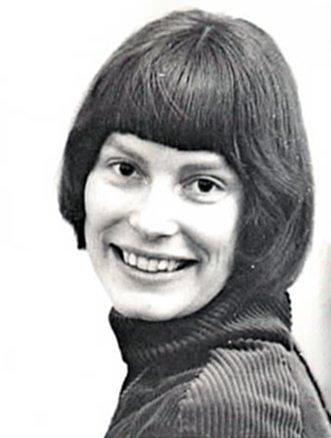
In addition to recording songs and instrumental music from many Travellers in the berryfields of Blairgowrie, Rokus and Marita called on celebrated tradition bearer Belle Stewart and family while in the area. Moving further north, they visited John ‘Molecatcher’ McDonald of Pitgaveny, who performed many songs with his characteristic melodeon accompaniment. Performers in Tain, including Robert Macrae and Mararet 'Peggy' MacLeod, contributed songs and pipe/fiddle music, while many Gaelic songs were recorded in Cromarty and Muir-of-Ord from the likes of Peter Dalgetty and Belle Anne MacAngus . In total, Marita and Rokus made a great many recordings - 26 reel-to-reel tapes - over much of the north of Scotland.
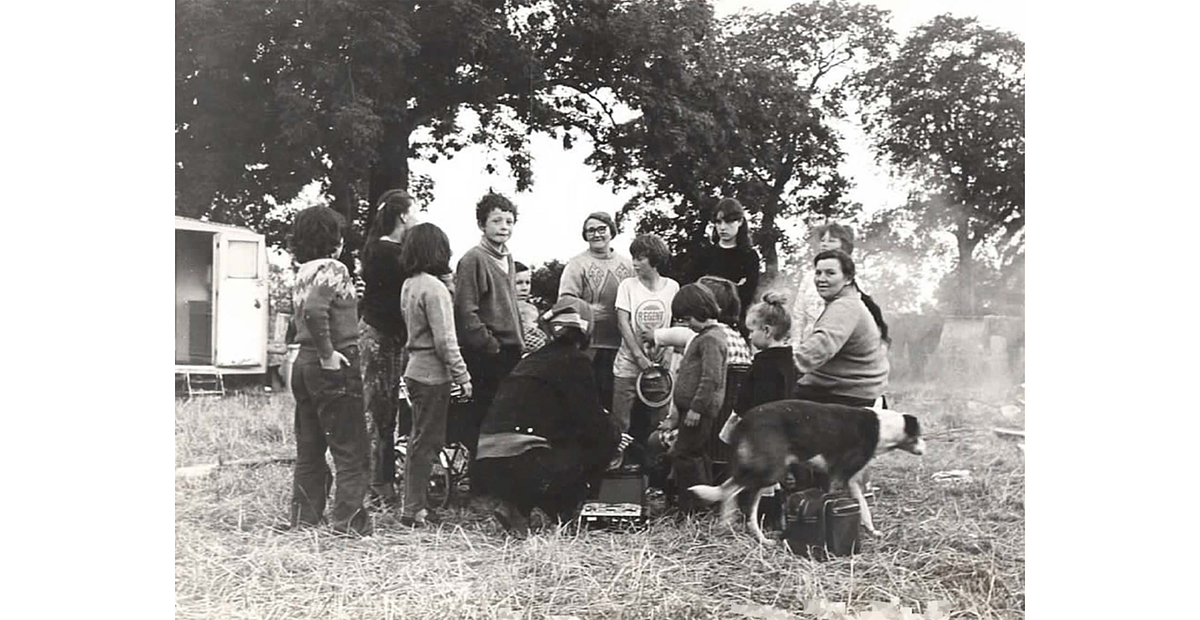
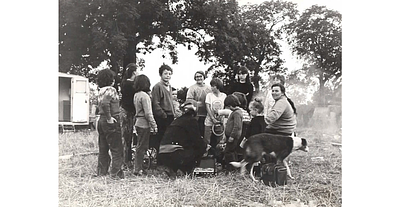
Travellers at Marshall's farm, 1971
Rokus' experience of Scottish traditional music left a deep and lifelong impression on his subsequent career as a composers and professor of musicology, lasting up to the present day:
"What especially touched me and still fascinates me, is the intimate intensity of solo singing (without accompaniment): during home ceilidhs, singers, as well as the others present were visibly absorbed in the unfolding of the sound - no printed paper interfered in their personal renderings of personal versions of a ballad or song. This inspired me to compose solo voice song cycles, like 'In Love with the Dancer: Songs of Mirabai' for soprano or tenor (1993) and recently 'A quintet of Rumi quatrains for bass solo' (2023). [...] Meeting with Gaelic poet Sorley Maclean [...] inspired me to compose 'Winds of a Far Air' for flute and soprano saxophone. Yet another source of inspiration still moves me: the Gaelic Psalm singing in the Hebrides."
Marita was likewise deeply affected by her time in Scotland:
"During one of the weekends there was a sing around that I would never forget. At a certain moment I was told: now it’s your turn and we would like to hear a song from your country now. I didn’t expect that at all and all I could think of was to sing a simple Dutch children’s song. When I returned to The Netherlands after the fieldwork, I was so enthusiastic about traditional Scottish music that I joined a folk group that played and sang this music. The name of that group, which consisted of 4 musicians, was ‘Fowre’. And what was new for me: I had to sing and play everything by heart in that group. […] I often thought of those Travellers in Scotland who’d expected me to sing a Dutch song. My graduation thesis - 'De mythe van het volkslied’ ('The myth of the folk song') was about the limited attention that traditional Dutch songs received in the media and in music education.”

From a mystery that began with a single surname, we now have a rich story of two young students discovering Scotland's traditions for themselves, and in turn finding lifelong influences for their own music-making careers.
We'll be continuing to identify unknown fieldworkers and contributors for a long time to come, and are excited to uncover and share their stories with you. We're grateful to Marita and Rokus for their kind permission to publish their recordings, and for providing photographs of their fieldwork.